
Why the Wall Stays Open After an Emergency Plumbing Repair
Because two parties are entitled to see it before it is covered. Onondaga County Plumbing Control lets emergency work start without a permit, but requires the permit on the first business day and forbids covering the work before it is inspected, and New York's insurance regulator says your insurer has the right to inspect the damage before any permanent repair. A wall left open for a few days is the rule working, and it is also what keeps a claim intact.
Already know you need someone out? Call (315) 640-3590.
From the emergency repair to a closed wall
Emergency work begins
No permit needed yetOnondaga County lets plumbing work start without a permit in an emergency.
The permit is obtained
First business day afterA Saturday night burst usually means a Monday permit.
Plumbing Control inspects
Before anything is coveredNothing goes behind drywall or under backfill until the county has seen it.
The insurer sees the damage
Before permanent repairsNew York's regulator says the insurer can refuse to pay for damage repaired before inspection.
Wall closed, permanent repair quoted
In daylightWith photographs of the open cavity and the new work kept for your own file.
Onondaga County WEP Plumbing Control permit requirements; NY Department of Financial Services, What to Do After a Loss.
The county's rule for emergency plumbing work
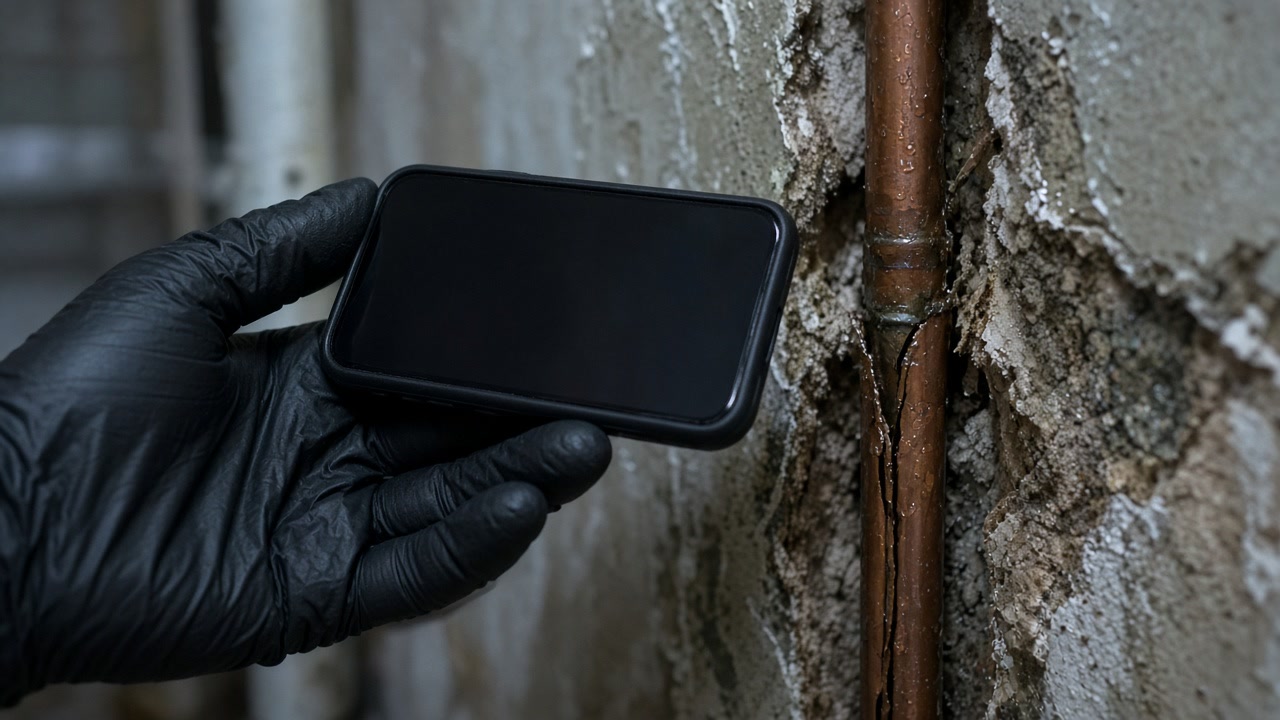
An open wall after an emergency visit usually means the plumber followed the rules rather than cut a corner. Onondaga County Plumbing Control, the WEP division that issues plumbing permits across the county, sets three rules that apply here. A permit normally comes before the work. An emergency is the exception, and then the permit is due on the next business day. And whatever was done stays uncovered, unburied and in plain view until the county's inspector has seen it. So a pipe that let go on a Saturday night can be repaired on Saturday night, the permit follows on Monday, and the new work stays visible until the county has looked at it. Drywall screwed back over a new joint is concealment in the plainest sense, and a repair closed up before its inspection is a repair that may have to be opened again. The practical effect for you is a hole in the wall for a few days, a tarp or a sheet of plastic over it, and a date to wait for.
What the adjuster needs to be able to see
The county is one reason the wall stays open. Your insurer is the other, if you are claiming. New York's Department of Financial Services says no permanent repairs should be made until the company or its representative has inspected the property, that the company has the right to inspect it in its damaged condition, and that it can refuse to pay for damage that is repaired before inspection. The open wall is the damaged condition. It shows the failed pipe, how far the water traveled inside the cavity and what it soaked on the way, which photographs of a finished wall cannot. The opening itself is also part of what a standard policy expects: the ISO HO-3 form, where the water damage is covered, includes the cost to tear out and replace part of the building when that is necessary to repair the plumbing system, while excluding the pipe that failed. Closing the wall early does not save that cost. It can turn it into one nobody will reimburse.
A temporary repair is meant to hold for days, not years
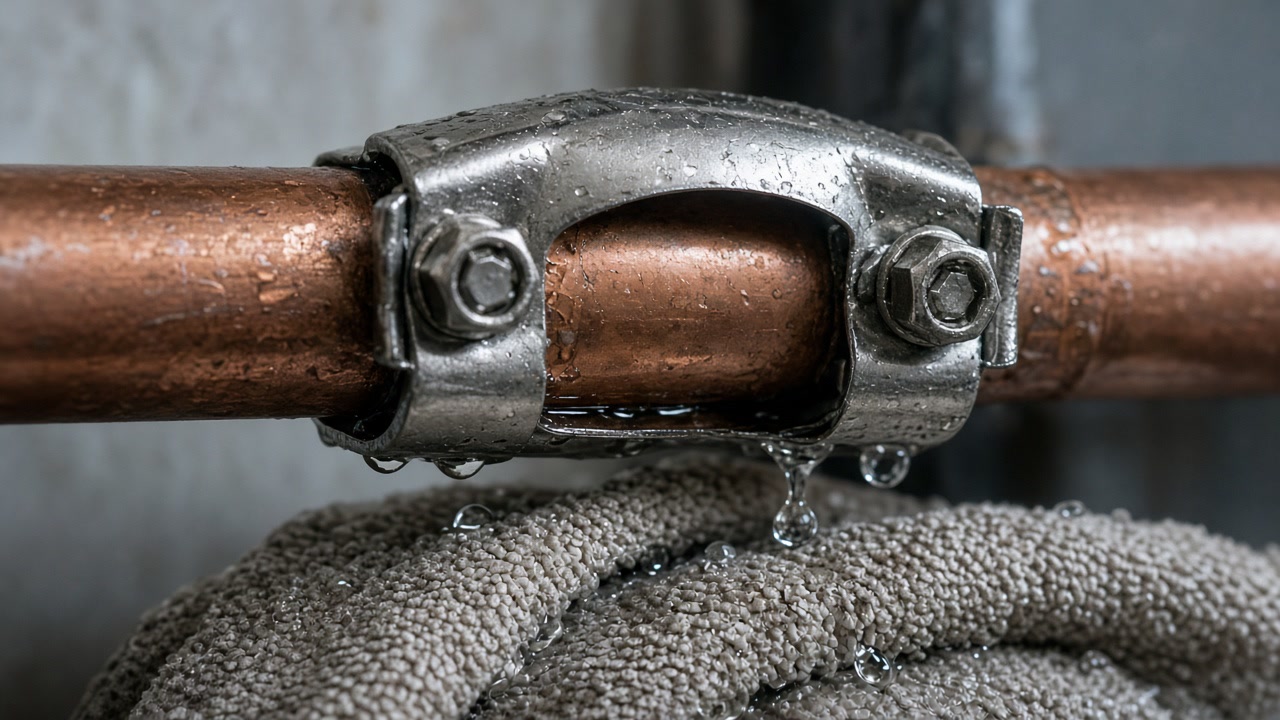
What the plumber did tonight is usually enough to stop the leak and get water back to the house, and it is not meant to be the finished job. That is by design. The state's insurance guidance says the cost of protecting the property against further damage is generally covered and reimbursed, and to save all receipts for temporary fixes, and the standard form's Reasonable Repairs provision pays the reasonable cost of necessary measures taken solely to protect covered property from further damage, without raising the limit on the policy. Before the plumber leaves, ask which part of what they did is temporary, what the permanent repair will involve and whether a permit is needed for it. Keep the answer in writing with the receipt. It means the permanent work can be quoted in daylight, by them or by someone else, against a clear description rather than a guess.
Repairs that need no permit and no county inspection
Not every emergency leaves you waiting on the county. Onondaga County Plumbing Control states that repair or replacement, in kind, of a faucet, a flush valve, a supply tube, an individual fixture stop, a toilet fill valve or a flushing mechanism does not require a plumbing permit. If what failed was a braided supply tube behind a toilet or under a vanity, and it was replaced like for like, there is no Plumbing Control inspection to wait for. The only remaining reason to leave the opening is your insurer, and if you have decided the damage is too small to claim, that reason goes too. The wall can then be closed once you have photographed it for your own records and are satisfied nothing is still leaking. This is worth knowing before anyone quotes you for a return visit to close up a hole that nobody is required to inspect.
If you rent: the water can go off for the repair, not stay off
In the City of Syracuse, where 58.4 percent of occupied homes are rented according to Census estimates, an open wall is often a tenant's problem to live with and a landlord's to resolve. Section 27-14 of the Syracuse Property Conservation Code says a service the code requires in an occupied home, water among them, may not be shut off or discontinued by the owner or anyone else, and it carves out necessary repairs and emergencies. So a landlord may turn the water off to have the pipe repaired; the code does not let it stay off once the repair is done. New York Real Property Law section 235-b adds that every residential lease carries a warranty that the home is fit to live in and free of conditions dangerous to health or safety, and that any agreement waiving that right is void. If water or another required service stays off, the office that enforces the city code is the Division of Code Enforcement, on 315-448-8695 or codeenforcement@syr.gov, Monday to Friday during office hours.
How to know it is ready to close, and who to ask
Three things settle it. Plumbing Control has inspected the work, or the repair was one of the in kind fixture jobs that needs no permit. Your insurer has inspected, or has told you in writing that it will not. And you have your own photographs of the open cavity, the failed pipe and the new work, taken before a single sheet of drywall goes back. If you are unsure where a permit stands, the office that issues plumbing permits and inspects the work countywide is Onondaga County Plumbing Control. Its number is 315-435-6614, and the office is at 650 Hiawatha Boulevard West. Closing the wall is ordinary work that can be booked in ordinary hours once those three are in place. If the leak is not yet stopped, that is the part that cannot wait: tell us what happened, where the water is coming from and whether the main shutoff is closed, and we will put you in touch with a licensed, insured plumber working in your town.
Sources used in this guide
Onondaga County Plumbing Control states that plumbing permits must be obtained before any work except in an emergency, that in an emergency a permit must be obtained on the first business day following it, and that the work cannot be covered, backfilled or concealed before Plumbing Control has inspected it.
Source: Onondaga County Department of Water Environment Protection, accessed 2026-09-24
The NY DFS guide says it is important to protect property against further damage, that the cost of that protection is generally covered and reimbursed, and to save all receipts for temporary fixes. It states that no permanent repairs should be made until the company or its representative has inspected the property, that the company has the right to inspect the property in its damaged condition, and that it can refuse to pay for damage that is repaired before inspection.
Source: New York State Department of Financial Services, accessed 2026-09-24
Under the ISO HO 00 03 form, loss caused by an accidental discharge or overflow of water from within a plumbing, heating or air conditioning system or a household appliance is covered, including the cost to tear out and replace part of the building when that is necessary to repair the system or appliance. The form states that it does not cover loss to the system or appliance from which the water escaped.
Source: Insurance Services Office, via Maine Bureau of Insurance, accessed 2026-09-24
The Reasonable Repairs additional coverage in the ISO HO 00 03 form states the insurer will pay the reasonable cost incurred by the policyholder for necessary measures taken solely to protect covered property that is damaged by a covered peril from further damage. It does not increase the limit of liability that applies to the property.
Source: Insurance Services Office, via Nevada Division of Insurance, accessed 2026-09-24
Onondaga County Plumbing Control states that repair or replacement of a faucet, flush valve, supply tube, individual fixture stop, toilet fill valve or flushing mechanism, in kind to what is already there, does not require a plumbing permit.
Source: Onondaga County Department of Water Environment Protection, accessed 2026-09-24
American Community Survey 2020 to 2024 estimates put 34,927 of the City of Syracuse's 59,816 occupied housing units, 58.4 percent, as renter occupied, the highest share of the sixteen towns in this metro. Of 67,601 units, 7,785, or 11.5 percent, were vacant, and 4,262 of those were classed as other vacant rather than for rent, for sale or seasonal.
Source: US Census Bureau, American Community Survey 2020 to 2024 five year estimates, accessed 2026-09-24
Section 27-14 of the Syracuse Property Conservation Code forbids any owner, occupant or responsible person to remove, shut off or discontinue any service, facility, equipment or utility the code requires for an occupied dwelling unit, except for necessary repairs, alterations or emergencies. Section 27-13 makes occupants responsible for keeping plumbing fixtures clean and sanitary and for reasonable care in their operation and use.
Source: City of Syracuse, accessed 2026-09-24
New York Real Property Law section 235-b provides that in every written or oral residential lease the landlord is deemed to warrant that the premises and common areas are fit for human habitation and free of conditions dangerous, hazardous or detrimental to life, health or safety, except where the condition was caused by the misconduct of the tenant. Any agreement by a tenant waiving or modifying these rights is void as contrary to public policy.
Source: New York State Senate, accessed 2026-09-24
The City of Syracuse Division of Code Enforcement lists its contact as 315-448-8695 and codeenforcement@syr.gov, with office hours Monday to Friday 8:30 a.m. to 4:30 p.m.
Source: City of Syracuse Division of Code Enforcement, accessed 2026-09-24
Onondaga County Plumbing Control, the division of WEP that issues plumbing permits countywide, lists its office at 650 Hiawatha Boulevard West, Syracuse, telephone 315-435-6614, on its June 2026 residential water heater permit checklist.
Source: Onondaga County Department of Water Environment Protection, accessed 2026-09-24
Services this guide relates to
Need someone to look at it?
Send the details and we will come back to you.